
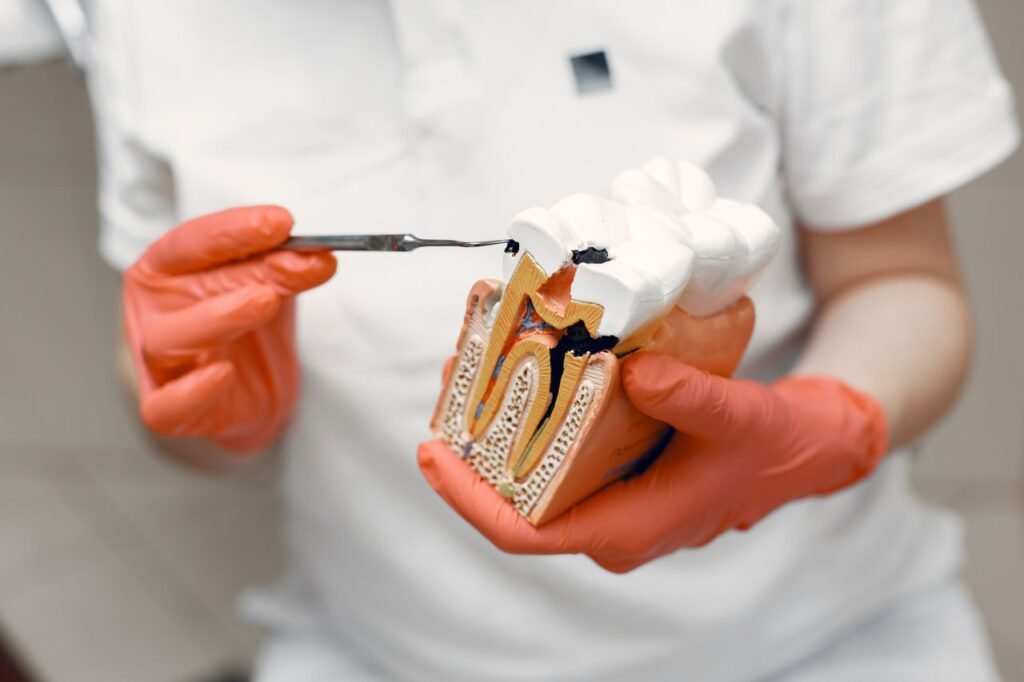
If you leave a cavity untreated, it keeps growing. Decay moves from the enamel into the softer dentin, then into the nerve (pulp), where it can cause severe pain, infection and an abscess. A small cavity is common and simple to fix with a filling. Once it reaches the nerve, it’s serious and usually needs a root canal or extraction. Regular preventive dentistry catches cavities while they’re still small, quick and comfortable to treat.
People delay treatment for real reasons: they’re busy, worried about pain, or the tooth simply doesn’t hurt yet. We hear all of those reasons at Enhance Dental Centre, and we understand them. The trouble is that cavities don’t heal on their own once they’ve broken through enamel, and the “no pain” stage is exactly when treatment is easiest.
If decay does reach the nerve, endodontics (root canal treatment) can often save the tooth. When a tooth is too damaged to keep, gentle tooth extractions remove the source of infection so the area can heal.
And if a tooth is lost, replacing it with dental implants protects your bite and jawbone. That’s the far end of the timeline, though. The goal is to never get there.
What is a cavity?
A cavity (dental caries) is a permanently damaged area in the hard surface of a tooth caused by acids from bacteria in plaque. Bacteria feed on sugars and starches, produce acid, and that acid dissolves minerals from enamel. Over time, a weak spot becomes a hole.
Early demineralization (a white spot) can sometimes reverse with fluoride and better habits. Once the enamel surface breaks down into a true cavity, it needs professional treatment.
The stages of an untreated cavity
Stage 1: Enamel demineralization
A chalky white spot appears. No pain. This stage can sometimes be reversed with fluoride, diet changes and good brushing.
Stage 2: Enamel decay
The enamel surface breaks down and the spot may turn brown. Still usually painless. A small filling fixes it.
Stage 3: Dentin decay
Decay reaches the dentin, which is softer and spreads decay faster. You may feel sensitivity to sweets, cold or hot. A larger filling or an inlay may be needed.
Stage 4: Pulp involvement
Bacteria reach the nerve and blood vessels inside the tooth. Pain can become sharp, throbbing, or keep you up at night. A root canal is often needed to save the tooth.
Stage 5: Abscess
Infection spreads past the root tip into the bone, forming a pocket of pus. Signs include swelling, a pimple on the gum, a bad taste, fever, or pain when biting. This needs prompt care.
Stage 6: Tooth loss or spreading infection
The tooth may break down so much it can’t be saved. In rare cases, infection spreads to the face, neck or bloodstream, which is a medical emergency.
How fast does a cavity grow?
There’s no single answer. Some cavities take years to move through enamel. Others, especially in children, people with dry mouth, or those who sip sugary drinks often, can reach the nerve within months.
Once decay reaches dentin, it usually speeds up because dentin is softer and has tiny tubules that let bacteria travel. That’s why waiting “until it hurts” often means waiting until it’s much bigger.
Treatment options by stage
| Stage | Typical treatment | Visits |
|---|---|---|
| White spot | Fluoride, diet and hygiene changes | Monitoring at checkups |
| Small enamel cavity | Small tooth-coloured filling | Usually 1 |
| Dentin cavity | Larger filling, inlay or onlay | 1 to 2 |
| Large cavity weakening the tooth | Crown, sometimes with a filling core | 1 to 2 |
| Pulp infection | Root canal treatment, then a crown | 2 to 3 |
| Tooth not restorable | Extraction, then implant, bridge or denture | Several |
Signs you might have a cavity
- Sensitivity to sweets, cold or hot that lingers
- A visible hole, dark spot or rough area
- Food catching in the same place
- Pain when biting
- Bad breath or a bad taste that won’t go away
- Floss that shreds on one spot
Many cavities, especially between teeth, show none of these signs until they’re advanced. That’s why checkups and X-rays matter.
Where do hidden cavities form?
Between teeth
Interproximal cavities start where teeth touch. You can’t see them in a mirror, and floss may only catch on them once they’re large. Bitewing X-rays are the main way to find them.
Under old fillings and crowns
Over the years, the edges of fillings and crowns can open slightly, letting bacteria in. This “recurrent decay” can spread underneath without much warning.
On root surfaces
When gums recede, root surfaces are exposed. Roots have no enamel, so decay moves faster. Root cavities are especially common in adults over 50 and people with dry mouth.
In deep grooves of back teeth
Pits and fissures on chewing surfaces trap food. Children and teens are particularly prone here, which is why sealants help.
Who is at higher risk of fast-growing cavities?
- People who snack or sip sugary drinks throughout the day
- Anyone with dry mouth from medications, health conditions or mouth breathing
- People with braces, which make cleaning harder
- Adults with gum recession and exposed roots
- People with acid reflux or frequent vomiting
- Those who haven’t had a checkup in more than a year
If several of these apply, shorter intervals between checkups and extra fluoride are worth discussing.
When is it an emergency?
Seek urgent care if you have: facial or jaw swelling, fever, a bad taste with swelling, trouble opening your mouth, difficulty swallowing or breathing, or severe pain that pain relievers don’t control. Swelling that spreads toward the eye or neck, or difficulty breathing, needs a hospital emergency department right away. This article is general information and doesn’t replace an exam by a licensed dental professional.
For dental pain without those red-flag signs, an Emergency Dentist in Vancouver can usually see you the same day or next day to relieve pain and stop infection.
What to expect at your first visit (step by step)
- Welcome and history: we ask about symptoms, health conditions and dental fears.
- Exam: a careful look at every tooth, the gums and soft tissues.
- X-rays if needed: to see decay between teeth and under fillings.
- Diagnosis in plain language: we show you what we see on screen.
- Options: each choice is explained, with pros and cons.
- Comfort plan: freezing, breaks and pacing that suit you.
- Treatment or scheduling: sometimes the same day, otherwise at a time that works.
- Follow-up: prevention tips and your next checkup.
General, restorative and cosmetic care: what’s the difference?
| Type | Goal | Examples |
|---|---|---|
| General / preventive | Keep teeth healthy and catch problems early | Exams, cleanings, X-rays, fluoride, oral cancer screening |
| Restorative | Repair damage and restore function | Fillings, crowns, root canals, bridges, implants, dentures |
| Cosmetic | Improve appearance | Whitening, veneers, composite bonding, Invisalign |
Untreated cavities push people from the first row into the second. Regular general care keeps most patients there.
Myths about cavities
“If it doesn’t hurt, it can wait.”
Pain usually means decay is already deep. Painless cavities are the easiest and most comfortable to fix.
“Baby teeth cavities don’t matter.”
Decay in baby teeth can cause pain, infection and damage to the adult tooth below.
“A cavity can heal by itself.”
Only early white-spot lesions can remineralize. Once there’s a hole, it needs treatment.
“Fillings are painful.”
With modern local anaesthetic, most people only feel pressure and vibration. Small fillings often take less than 30 minutes.
Common mistakes people make with cavities
- Waiting for pain before booking
- Using painkillers for weeks to mask a toothache
- Skipping X-rays that would catch decay between teeth
- Assuming a tooth that stopped hurting has healed (the nerve may have died)
- Chewing on the other side for months, which can cause jaw strain
Real patient scenarios
Scenario 1: A UBC student noticed sensitivity to cold drinks on one molar for a few months. An exam found a moderate cavity in the dentin. One appointment and a tooth-coloured filling later, the sensitivity was gone.
Scenario 2: A Kitsilano parent ignored a throbbing tooth during a busy month. When she came in, the tooth had an abscess. A root canal and crown saved it, but it took 3 visits instead of 1. She said she wished she’d booked when it first felt “off.”
How to prevent cavities
- Brush twice a day with fluoride toothpaste.
- Clean between teeth daily.
- Limit snacking and sipping sugary or acidic drinks.
- Drink tap water, which is fluoridated in some areas, and rinse after coffee or sweets.
- Chew sugar-free gum after meals to boost saliva.
- Get checkups and cleanings every 6 months, or as advised.
- Ask about sealants and fluoride if you’re cavity-prone.
How to choose a dental clinic in Kitsilano
- Check that dentists are registered with the provincial regulator
- Look for clear explanations and treatment options, not pressure
- Read recent patient reviews
- Consider hours that fit your schedule, including evenings
- Ask about comfort options if you’re anxious
- Confirm they accept your plan, including CDCP
Cavity care at Enhance Dental Centre
If you’re looking for a Dentist in Kitsilano who explains things clearly and treats you gently, Enhance Dental Centre is one of the most trusted names in Kitsilano and Vancouver, with a 5.0 Google rating from over 270 patient reviews. We accept new patients and CDCP (Canadian Dental Care Plan) patients.
All treatment is provided by licensed dental professionals registered with the College of Dental Surgeons of British Columbia (CDSBC), which now operates as part of the BC College of Oral Health Professionals.
Our Dental Clinic in Kitsilano is at 2219 West Broadway, Vancouver, BC V6K 2E4. New patients can call 604-210-3603, existing patients can call 604-733-1022, and you can email care@enhancedentalcentre.com. Hours are Monday to Tuesday 8:00 AM to 5:00 PM, Wednesday to Thursday 10:00 AM to 7:00 PM, and Friday 8:00 AM to 4:00 PM, so evening appointments are available midweek.
Frequently asked questions
How long can a cavity go untreated?
It varies from months to years depending on your diet, saliva, fluoride use and where the cavity is. Because there’s no way to predict it, it’s best to treat a cavity soon after it’s found.
Can an untreated cavity make you sick?
In some cases, yes. If decay reaches the nerve, infection can spread to the jawbone and, rarely, to other parts of the body. Swelling, fever or difficulty swallowing need urgent care.
Why did my toothache suddenly stop?
The nerve inside the tooth may have died. The infection is often still there and can form an abscess, so the tooth still needs to be checked.
Is a filling or root canal better?
A filling is used when decay hasn’t reached the nerve. A root canal is needed when the nerve is infected or inflamed beyond repair. Your dentist will recommend the least invasive option that will last.
Can I get a cavity filled the same day?
Often, yes. If the schedule allows and the cavity is straightforward to treat, many fillings can be done at the same visit where the cavity is diagnosed.
Conclusion
An untreated cavity keeps growing and can lead to pain, infection, root canals or tooth loss. Small cavities are quick and comfortable to fix with a filling. Regular checkups catch decay early, before it turns into a bigger problem.