3D Imaging in Kitsilano, VancouverWhy a CBCT Scan Gives Your Dentist a Clearer Picture
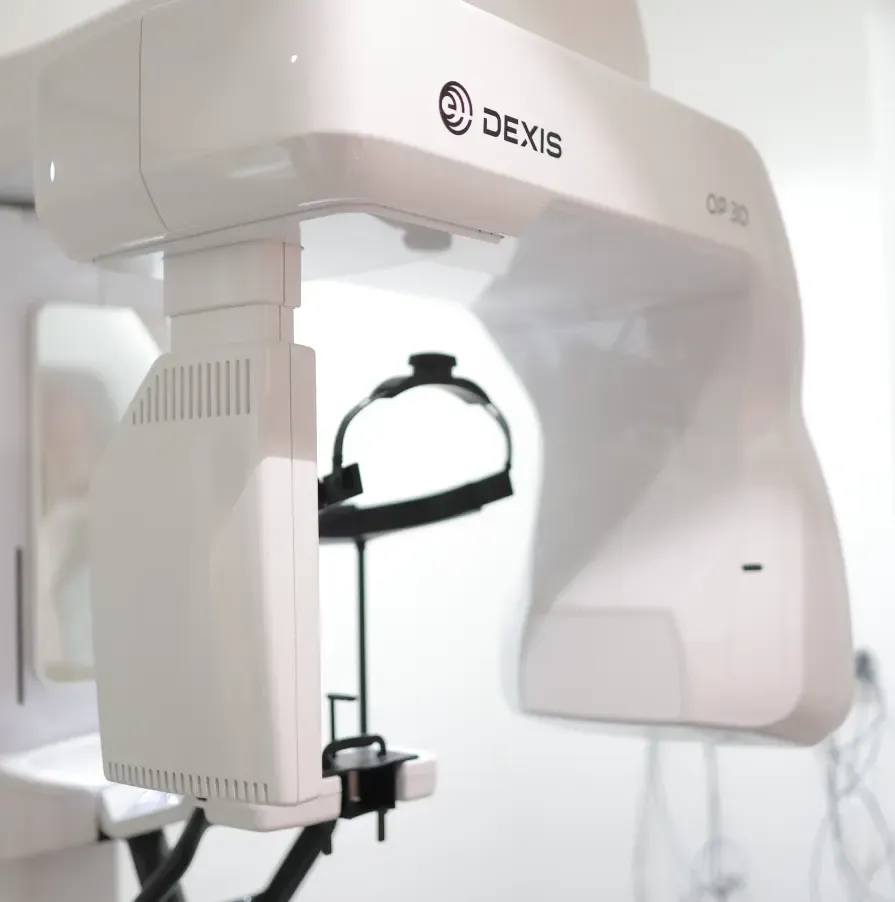
A Cone Beam CT scan builds a complete three-dimensional model of your teeth, jaw and sinuses in under a minute, right here at Enhance Dental Centre. It is one of the most useful diagnostic tools for planning implants, extractions, root canals and orthodontics with precision.
Reviewed by the Enhance Dental Centre clinical team. Updated October 2026.
Quick answerA CBCT scan (Cone Beam Computed Tomography) is a fast, low-dose 3D X-ray that captures your teeth, jawbone, nerves and sinuses in a single 20 to 40 second rotation. Enhance Dental Centre in Kitsilano uses CBCT imaging to plan dental implants, wisdom tooth removal, root canals and complex restorative cases with far more precision than a standard 2D X-ray.
How CBCT Imaging Works
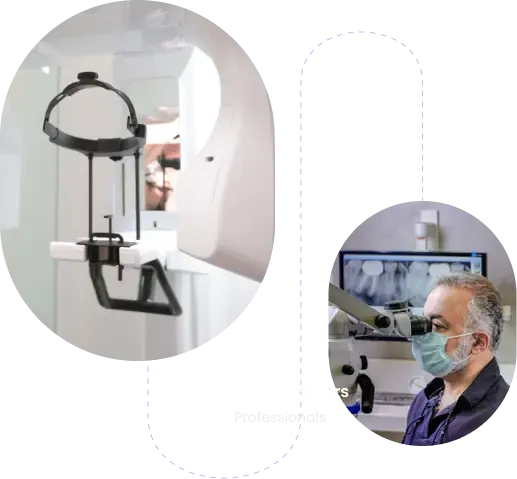
Traditional dental X-rays send a flat beam through your jaw to create a single two-dimensional picture, similar to a photograph. A CBCT scanner instead rotates a cone-shaped X-ray beam around your head, capturing hundreds of individual images from different angles in one pass. Specialized software then reconstructs those images into a detailed three-dimensional model that your dentist can rotate, slice and measure on screen.
This 3D view reveals information a flat X-ray simply cannot show: the exact width and density of your jawbone, the precise path of nerves and blood vessels, the position of impacted teeth, and the internal anatomy of root canals. At Enhance Dental Centre, that level of detail lets us plan treatment with far greater confidence before any instrument touches your mouth.
CBCT vs Traditional Dental X-Rays
| Feature | CBCT scan | Standard 2D X-ray | Panoramic X-ray |
|---|
| Dimension | Full 3D volumetric image | Flat 2D image | Flat, wide 2D image |
| Best for | Implants, impactions, complex root canals, bone assessment | Cavity checks, routine monitoring | Full-arch overview, orthodontic planning |
| Detail level | Very high, measurable in 3 dimensions | Moderate | Moderate, wide field of view |
| Scan time | 20 to 40 seconds | A few seconds per image | Under 20 seconds |
| Radiation dose | Low, higher than a single 2D X-ray but far below a medical CT | Very low | Low |
We do not replace routine X-rays with CBCT. Instead, CBCT is reserved for cases where its extra detail changes the treatment plan, such as confirming bone volume before an implant or locating a hidden canal during root canal treatment.
When We Recommend a CBCT Scan
Dental implant planning
Measuring bone volume, density and proximity to nerves before placing a dental implant, so the implant is positioned accurately the first time.
Wisdom tooth evaluation
Identifying impaction and the exact relationship between the tooth roots and the nerve before extraction.
Root canal treatment
Locating extra or curved canals that are easy to miss on a flat X-ray, supporting more predictable endodontic treatment.
Orthodontic and airway assessment
Evaluating jaw relationships, tooth positions and airway space as part of comprehensive treatment planning.
Oral surgery
Mapping anatomy precisely before procedures performed through our oral surgery service.
What a CBCT Scan Can Reveal That a Flat X-Ray Cannot
Because a flat X-ray compresses a three-dimensional structure into a single plane, overlapping teeth, roots and bone can hide important details or create misleading shadows. A CBCT scan removes that guesswork. Your dentist can scroll through cross-sections of your jaw in any direction, measure bone width to the fraction of a millimetre, and see exactly how close a nerve canal sits to a wisdom tooth or implant site. For patients with complex anatomy, a history of failed treatment elsewhere, or a tooth that has been difficult to diagnose on standard X-rays, this extra clarity often changes the recommended treatment plan entirely, sometimes avoiding a procedure that would not have worked as expected.
Common conditions CBCT helps us evaluate
- Hidden infections or cysts that do not show clearly on a 2D X-ray
- Jawbone loss that needs to be addressed before implant placement
- Impacted or displaced teeth, including wisdom teeth near the nerve
- Fractures in teeth or jawbone following an injury
- Sinus position and health when planning upper jaw implants
- Airway dimensions relevant to sleep and breathing concerns
What to Expect at Your CBCT Appointment
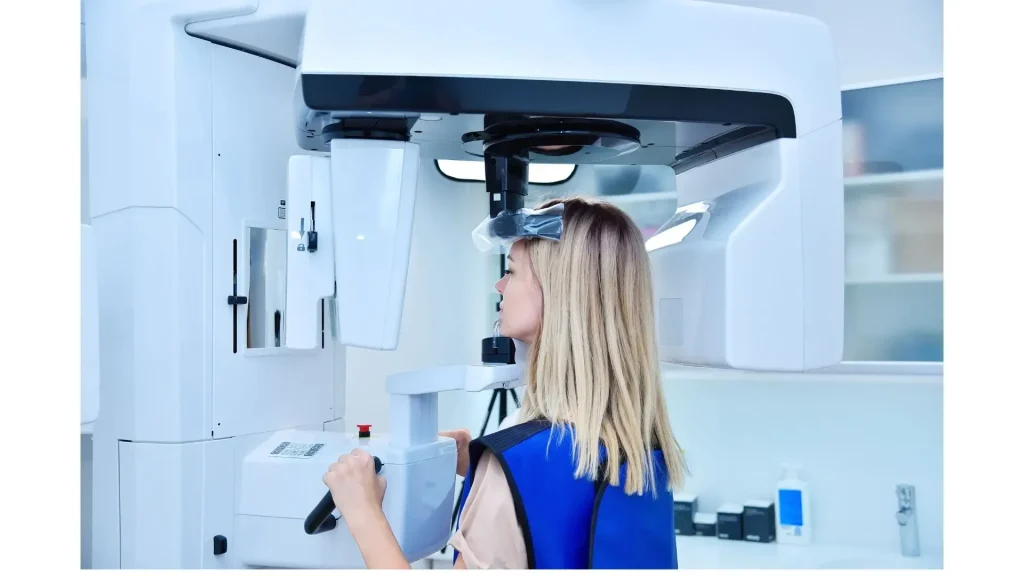
- Check-in and positioning. You will be asked to remove glasses, jewelry or anything metal near your head, then positioned comfortably in the scanner, either standing or seated depending on the unit.
- The scan. The scanner arm rotates once around your head while you stay still. The capture itself takes only 20 to 40 seconds.
- Image processing. Software reconstructs the raw images into a 3D model within minutes, ready for your dentist to review.
- Review with your dentist. We walk through the images with you on screen, pointing out what they mean for your treatment plan.
- Treatment planning. The CBCT data is used to plan your procedure precisely, whether that is implant placement, extraction or root canal therapy.
Most patients are in and out within 15 to 20 minutes for the imaging appointment alone. If your CBCT scan is part of a same-day consultation, we will let you know the full expected length in advance.
Is CBCT Safe? Understanding the Radiation Dose
CBCT uses a lower radiation dose than a medical CT scan, and modern units are designed to keep the exposed area as small as possible. We follow the "as low as reasonably achievable" principle used across dentistry and medicine, which means we only recommend a CBCT scan when the additional detail will genuinely change how we plan or deliver your treatment. If a standard X-ray or panoramic image gives us enough information, we will use that instead.
Pregnant or planning a scan for a child? Let our team know. We will discuss whether a CBCT scan is necessary and, if so, how we minimize exposure for the situation.
Why Choose Enhance Dental Centre for CBCT Imaging in Kitsilano
Having in-office CBCT technology means you do not need a separate referral and a second appointment across town. Your scan, your consultation and your treatment planning all happen in one place at 2219 West Broadway. Our team is registered with the College of Dental Surgeons of British Columbia and follows strict imaging and infection control protocols for every patient. If you are a CDCP member, ask our team whether your imaging and related treatment qualify for coverage.
Preparing for Your CBCT Appointment
No special preparation is needed before a CBCT scan. We recommend wearing clothing without metal zippers or collar pieces near the neck, and letting us know in advance if you have a pacemaker, are pregnant, or have any concerns about radiation exposure. If your scan is being taken to plan a specific procedure, such as an implant consultation or an evaluation for Invisalign or orthodontic treatment, let the front desk know so we can combine your imaging and consultation into a single, efficient visit.
CBCT and Your Overall Treatment Journey at Enhance Dental
A CBCT scan is rarely the end goal on its own. It is a planning tool that feeds directly into the next step of your care. If imaging shows adequate bone for an implant, we move forward with a precise surgical guide based on your scan. If it reveals an extra canal during root canal evaluation, your endodontic treatment is planned around that finding from the start rather than discovered mid-procedure. If it shows a wisdom tooth sitting close to a nerve, we can discuss the safest extraction approach, or refer you for an oral surgery consultation with complete information in hand.
Because the imaging, consultation and treatment planning all happen under one roof at our Kitsilano clinic, you avoid the delay and inconvenience of being referred to a separate imaging centre and waiting for files to be transferred. Your dentist reviews the 3D model with you directly, in the same visit, and can answer questions about what the images show in real time.
Who benefits most from in-house CBCT imaging
Patients considering dental implants, anyone with a tooth that has been difficult to diagnose on a standard X-ray, patients being evaluated for impacted wisdom teeth, and anyone undergoing more involved restorative work such as full mouth reconstruction tend to benefit the most from this level of detail. If you are unsure whether your situation calls for a CBCT scan, our team can review your history at a consultation and recommend the right imaging for your specific case, nothing more and nothing less.
CBCT Scans at Enhance Dental Centre: Frequently Asked Questions
Our patients ask these questions most often. You will also find the full answers in the accordion above.
Curious Whether You Need a CBCT Scan?
Book a consultation at Enhance Dental Centre, 2219 West Broadway, Kitsilano, Vancouver, BC V6K 2E4. We will determine whether 3D imaging will help plan your treatment.