
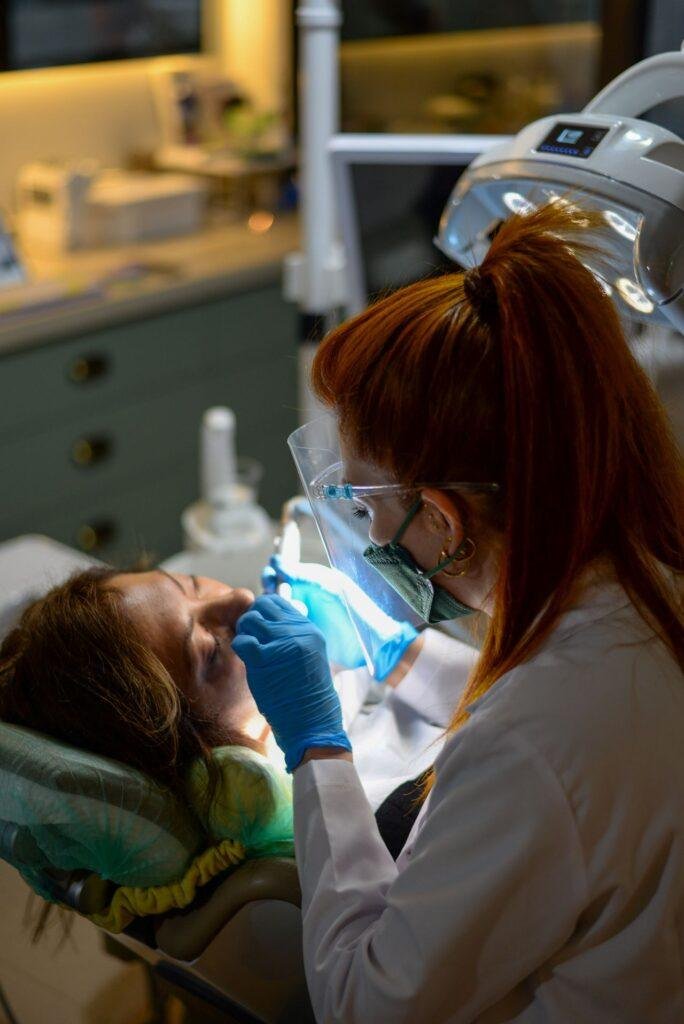
Wisdom teeth do not always need to be removed. Removal is recommended when they are impacted, repeatedly infected, decayed, or causing damage to the tooth in front, and in those situations it is a routine procedure rather than a serious operation. Symptom free wisdom teeth that are fully erupted and cleanable can often be monitored instead. A consultation about oral surgery begins with imaging, because the decision depends on position and root anatomy rather than age alone.
Third molars are the last teeth to develop, usually appearing between seventeen and twenty five. By that point the jaw is often too small to accommodate them cleanly, which is why partial eruption is so common.
Not every case requires a surgical approach. A fully erupted third molar can frequently be managed with a straightforward tooth extraction under local anaesthetic in a single short appointment.
The most common problem caused by a partially erupted wisdom tooth is gum infection around it. Where inflammation has spread along the gum, periodontal treatment is often needed alongside or instead of removal.
Clinical judgement varies between practitioners, so it is worth understanding the philosophy of the dentist in Kitsilano you consult before agreeing to surgery.
Where wisdom teeth are being kept under observation, consistent preventive hygiene care is what keeps them healthy and detects early decay behind the second molar.
If you are experiencing recurring soreness at the back of the jaw, the team at the dental clinic in Kitsilano can determine whether the cause is eruption, infection or something unrelated.
What Are Wisdom Teeth and Why Do They Cause Problems?
Wisdom teeth, or third molars, are the four teeth at the very back of the mouth. Some people never develop them at all, some develop one or two, and a minority have extra.
Problems arise from space and angle. When there is insufficient room, the tooth becomes impacted, meaning it cannot erupt into a normal functional position.
Types of Impaction
- Vertical. Upright but blocked by bone or the tooth in front.
- Mesial. Angled forward toward the second molar. The most common pattern.
- Distal. Angled backward toward the jaw.
- Horizontal. Lying sideways, often fully within bone.
Partial eruption creates the worst of both situations. A flap of gum overlaps the tooth, trapping bacteria in a space that cannot be cleaned.
When Removal Is Recommended
- Repeated pericoronitis, meaning infection of the gum around a partially erupted tooth
- Decay in the wisdom tooth or in the back surface of the second molar
- A cyst forming around the crown of an unerupted tooth
- Bone loss between the wisdom tooth and the second molar
- Persistent pain or swelling traced to the tooth
- Damage or resorption of the adjacent molar root
- Orthodontic or prosthetic planning that requires the space
When Monitoring Is Reasonable
- Fully erupted, functional and cleanable
- Deeply impacted with no symptoms, no decay and no cyst
- No pocketing or bone loss around the tooth
- The patient can maintain hygiene at that site
Routine removal of every asymptomatic wisdom tooth is no longer considered good practice. The current approach is individualised, based on imaging and documented findings.
The Removal Procedure Step by Step
- Assessment and imaging. A panoramic radiograph shows root shape, angle and proximity to the lower jaw nerve and the upper sinus. Three dimensional imaging is used when the nerve is close.
- Medical review. Medications, bleeding tendency, diabetes control and any bone medications are checked.
- Anaesthesia. Local anaesthetic numbs the area completely. Sedation is available for anxious patients or complex cases.
- Access. If the tooth is covered, a small gum flap is raised and a minimal amount of bone is removed.
- Sectioning. Impacted teeth are often divided into segments so each piece can be removed through a smaller opening. This reduces trauma rather than increasing it.
- Removal and cleaning. The socket is irrigated and any debris cleared.
- Closure. Dissolvable stitches are placed where a flap was raised.
- Aftercare briefing. Written instructions, pain relief guidance and a contact number are provided before you leave.
A single straightforward extraction takes around twenty to thirty minutes. Multiple impacted teeth may take an hour or more.
Healing Timeline
| Period | What to expect | What to do |
|---|---|---|
| First 24 hours | Numbness fades, mild oozing, swelling begins | Rest, cold compress, no rinsing, no straws, no smoking |
| Days 2 to 3 | Peak swelling and jaw stiffness | Warm salt water rinses, soft foods, pain relief as directed |
| Days 4 to 7 | Swelling subsides, opening improves | Gentle brushing near the site, gradual return to normal food |
| Week 2 | Gum surface closes, stitches dissolve | Resume full hygiene, avoid hard foods on the site |
| Weeks 3 to 8 | Socket fills with new tissue | Normal function, attend review if arranged |
| Months 3 to 6 | Bone remodelling completes | No restrictions |
Aftercare Rules That Matter Most
- Do not smoke or vape for at least seventy two hours, ideally longer. This is the biggest risk factor for a dry socket
- Avoid straws, vigorous rinsing and spitting for the first day
- Keep the head slightly elevated when resting
- Eat cool, soft foods on the first day and avoid very hot liquids
- Start warm salt water rinses from day two, several times daily
- Take pain relief before the anaesthetic wears off rather than waiting
- Avoid strenuous exercise for two to three days
Risks and Complications Explained Honestly
Wisdom tooth removal is common and generally safe, but no surgical procedure is risk free. Understanding the possibilities is part of informed consent.
- Swelling and bruising. Expected rather than a complication. Peaks at forty eight hours.
- Dry socket. Loss of the blood clot, causing a deep ache from day three to five. More common in smokers. Treated with dressing and irrigation.
- Infection. Uncommon. Signs are increasing pain after day four, swelling, a bad taste or fever.
- Bleeding. Minor oozing for a day is normal. Persistent bleeding needs review, particularly for patients on anticoagulants.
- Nerve disturbance. Temporary altered sensation in the lip, chin or tongue occurs in a small percentage of lower removals. Permanent change is rare and imaging is used specifically to reduce this risk.
- Sinus communication. Occasionally relevant for upper wisdom teeth with roots near the sinus floor.
- Jaw stiffness. Limited opening for several days is common and improves with gentle movement.
Contact the clinic promptly if pain increases after day four, swelling worsens rather than improves, you develop a fever, bleeding does not settle with pressure, or you notice numbness that is not resolving.
Removal Compared With Monitoring
| Consideration | Removal | Active monitoring |
|---|---|---|
| Best when | Impacted, infected, decayed or damaging the neighbour | Erupted, cleanable, no symptoms or radiographic change |
| Recovery | Several days of swelling and soft diet | None |
| Future risk | Problem removed permanently | Requires regular radiographs and hygiene review |
| Age factor | Younger patients heal faster with less complication risk | Risk of complications rises if removal becomes necessary later |
Myths About Wisdom Teeth and Dental Pain
Myth: everyone must have their wisdom teeth out. Removal is based on clinical findings. Many people keep healthy third molars for life.
Myth: wisdom teeth cause crowding of the front teeth. Evidence does not support this. Late lower incisor crowding occurs in people with and without third molars.
Myth: the surgery is extremely painful. The procedure itself is done under anaesthetic. Discomfort afterwards is usually well controlled with over the counter medication for a few days.
Myth: you should wait until they hurt. Waiting can mean decay in the second molar or bone loss that cannot be reversed. It also means healing at an older age, when recovery tends to be slower.
Myth: antibiotics will fix a wisdom tooth infection permanently. They settle an acute episode but do not remove the cause. Recurrence is common while the trapping gum flap remains.
Patient Scenarios
A Student With Recurring Swelling
A twenty year old has had three episodes of gum swelling behind the lower second molar over eighteen months. Imaging shows a mesially angled impacted third molar. Removal is recommended because the pattern will continue and the second molar is at risk.
A Patient in Their Fifties With No Symptoms
Both lower wisdom teeth are deeply impacted, fully covered by bone, with no cysts and no bone loss. Monitoring with periodic radiographs is entirely reasonable here, since surgical risk rises with age and there is no active problem.
Decay Behind the Second Molar
A partially erupted wisdom tooth has trapped plaque and caused a cavity on the back of the molar in front. The wisdom tooth is removed to give access, and the second molar is then restored. Delaying would risk losing the more valuable tooth.
Braces Planned
An orthodontic plan requires space at the back of the arch. Removal is coordinated with the orthodontic timeline rather than done in isolation.
Choosing Where to Have Wisdom Teeth Removed in Vancouver
Look for appropriate imaging before any decision, a clear explanation of why removal is or is not recommended, written aftercare instructions, and an accessible contact route for the first week. Surgery should be carried out by a dentist or specialist registered with the College of Dental Surgeons of British Columbia, which governs qualifications, sedation standards and infection control across the province.
Enhance Dental Centre is one of the most trusted dental clinics in Kitsilano and Vancouver, holding a 5.0 Google rating from over 270 patient reviews, and is located at 2219 West Broadway, Vancouver, BC V6K 2E4.
New patients are welcome and CDCP patients are accepted under the Canadian Dental Care Plan. Hours are Monday and Tuesday from 8:00 AM to 5:00 PM, Wednesday and Thursday from 10:00 AM to 7:00 PM, and Friday from 8:00 AM to 4:00 PM, so midweek evening appointments are available for consultations and reviews.
To arrange an assessment, new patients can call 604-210-3603, existing patients can call 604-733-1022, and written questions are welcome at care@enhancedentalcentre.com.
Frequently Asked Questions
What is the best age to have wisdom teeth removed?
When removal is clinically indicated, the late teens to mid twenties is generally the easiest period. Roots are not fully formed, bone is less dense, and healing is quicker with fewer complications. That said, age alone is not a reason to remove healthy, symptom free teeth.
How long does recovery take?
Most people return to normal daily activity within three to five days. Swelling peaks at around forty eight hours and then improves steadily. The gum surface closes within two weeks, while bone filling the socket continues quietly for three to six months without affecting how you feel.
Can all four wisdom teeth be removed at once?
Yes, and it is often preferred because it means one recovery period rather than several. The decision depends on complexity, medical history and your tolerance for a single longer appointment. Sedation makes combined removal much more comfortable for many patients.
What is a dry socket and how do I avoid it?
A dry socket happens when the protective blood clot is lost too early, exposing bone and causing a deep throbbing ache from around day three. The main preventable causes are smoking, using straws, vigorous rinsing and spitting in the first twenty four hours. It is treated quickly and effectively with a medicated dressing.
Do I need to stop my medication before surgery?
Never stop prescribed medication on your own. Tell the dental team about everything you take, including blood thinners, bone medications and supplements. They will liaise with your physician if any adjustment or precaution is needed, and in most cases no change at all is required.
Conclusion
Wisdom teeth only need removing when they are causing problems or clearly will, and imaging is what settles that question. When surgery is indicated, it is a routine procedure with a predictable recovery of a few days. Following aftercare instructions closely, particularly avoiding smoking and straws, is the single best way to ensure smooth healing.