
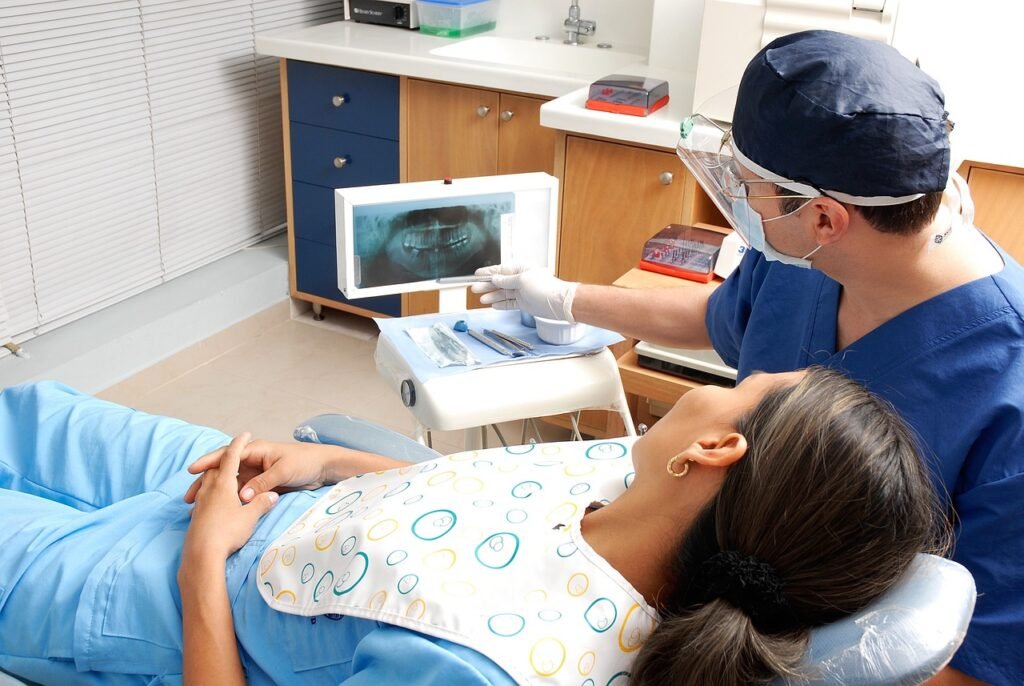
An endodontist is a dentist with 2 to 3 extra years of specialty training focused on the inside of the tooth: the pulp, nerve, and root canals. A general dentist handles your overall oral health, including many routine root canals. You usually see an endodontist for complex cases, like curved roots, retreatment, or tricky tooth pain. Needing a root canal is common and not a sign something rare is wrong. If your tooth hurts and you’re not sure who to see, endodontics in Kitsilano starts with a proper diagnosis either way.
Most people never think about this until a tooth throbs at 2 in the morning. Then the question becomes very practical. Who do I call, and will they be able to fix it? For most patients, the first call is their regular dental clinic in Kitsilano.
A general dentist is trained to diagnose tooth pain, treat many root canals, and decide when a referral makes sense. Some teeth are better removed than saved, and those cases go to oral surgery instead.
And plenty of root canals never need to happen at all. Regular preventive dentistry and hygiene catches cavities and cracks long before they reach the nerve.
Endodontist vs general dentist: quick answer
- General dentist: your main dentist for checkups, cleanings, fillings, crowns, and many straightforward root canals
- Endodontist: a specialist for complex root canals, retreatment, cracked teeth, and hard-to-diagnose tooth pain
- Training: endodontists complete dental school plus 2 to 3 years of specialty training
- How you get there: often by referral, though many accept direct bookings
What is an endodontist?
An endodontist is a dental specialist who diagnoses and treats problems with the dental pulp (the soft tissue inside the tooth containing nerves and blood vessels) and the tissues around the root tip. The word comes from Greek: endo means inside, odont means tooth.
Endodontists focus almost entirely on root canals, retreatments, and related surgery. Many perform hundreds of root canals a year, and they often use a surgical microscope and 3D imaging (CBCT) to see tiny canals.
What does a general dentist do?
A general dentist is your primary oral health provider. Think of them as the family doctor for your mouth. Their work covers 3 broad areas.
| Type of care | What it includes | Example |
|---|---|---|
| Preventive | Cleanings, exams, X-rays, fluoride, oral cancer screening | 6-month checkup and hygiene visit |
| Restorative | Fillings, crowns, bridges, root canals, dentures, implants | Repairing a broken molar |
| Cosmetic | Whitening, bonding, veneers, Invisalign | Brightening a smile before a wedding |
Many general dentists do root canals on front teeth and simpler premolars and molars. When a case gets complicated, they refer to an endodontist, or the endodontist may already work within the same clinic.
Endodontist vs general dentist: side-by-side
| General dentist | Endodontist | |
|---|---|---|
| Training | Dental school | Dental school plus 2 to 3 years of endodontic residency |
| Scope | Whole mouth, all ages | Inside of the tooth and root tips |
| Root canals | Many routine cases | Complex cases, retreatments, surgery |
| Equipment | Standard dental tools, digital X-rays | Often a surgical microscope and CBCT imaging |
| Ongoing care | Long-term checkups and cleanings | Usually returns you to your dentist afterward |
| How you book | Directly | By referral or directly, depending on the office |
When should you see an endodontist instead of your regular dentist?
Your general dentist will usually make this call. These are the common reasons for a referral.
- Curved, narrow, or calcified canals that are hard to find and clean.
- Extra canals, which are common in upper molars and easy to miss.
- A failed root canal that needs retreatment.
- A suspected cracked tooth where the crack’s depth needs careful assessment.
- Pain without a clear cause, where multiple teeth could be responsible.
- Apicoectomy, a small surgery to remove infection at the root tip when a standard root canal isn’t enough.
- Dental trauma, like a knocked-out or pushed-in tooth, especially in children.
What are the signs you might need a root canal?
Whether a general dentist or endodontist does the work, the warning signs are the same.
- Lingering sensitivity to hot or cold that lasts more than 30 seconds after the trigger is gone
- Throbbing pain, especially at night or when lying down
- Pain when biting or touching the tooth
- A tooth that has turned grey or darker
- A pimple-like bump on the gum near the tooth
- Swelling in the gum, face, or jaw
Some infected teeth don’t hurt at all. They show up as a dark spot at the root tip on an X-ray during a routine checkup.
Safety note
Facial swelling that spreads, fever, or trouble swallowing or breathing can mean a serious infection. Seek urgent care, and go to the hospital emergency department if breathing is affected. Antibiotics may calm infection temporarily, but the tooth itself still needs treatment.
What happens at a root canal appointment?
The steps are similar whether a general dentist or an endodontist does it. Here’s what to expect.
- Exam and X-rays. Sometimes a 3D scan for complex roots.
- Freezing. Local anaesthetic numbs the tooth and surrounding gum.
- Isolation. A thin rubber dam keeps the tooth dry and clean.
- Access. A small opening is made in the top of the tooth.
- Cleaning and shaping. Fine files remove infected pulp and disinfect the canals.
- Sealing. Canals are filled with a rubber-like material called gutta-percha.
- Temporary filling, then a permanent restoration. Back teeth usually need a crown.
Most root canals take 1 to 2 visits of about 60 to 90 minutes each.
Root canal myths, cleared up
“Root canals are extremely painful.”
Modern freezing makes the procedure feel similar to getting a filling. The pain people remember is usually the infection before treatment.
“Pulling the tooth is better.”
Saving a natural tooth usually keeps your bite more stable. Extraction then replacement with an implant or bridge takes more time and treatment.
“Root canals cause illness elsewhere in the body.”
This idea comes from research done about 100 years ago that has since been discredited. Current evidence doesn’t support it.
“Only specialists can do root canals.”
General dentists are trained to do them and do many safely. The key is recognizing which cases need a specialist.
Real patient scenarios
- The routine find. A 45-year-old had no pain, but her checkup X-ray showed a dark area under an old crown. Her general dentist did the root canal in one visit and replaced the crown.
- The hidden fourth canal. A man’s molar still ached weeks after a root canal elsewhere. An endodontist using a microscope found an extra canal that had been missed. Retreatment fixed it.
- The cracked molar. A patient felt sharp pain when releasing a bite. Testing showed a crack running down the root. Saving it wasn’t realistic, so it was removed and later replaced with an implant.
Common mistakes patients make
- Waiting for pain to go away instead of booking. It often stops because the nerve died, while infection continues.
- Taking leftover antibiotics without a diagnosis.
- Skipping the crown after a root canal on a back tooth, which raises the risk of fracture.
- Assuming a specialist is always needed, and delaying care while searching for one.
- Not mentioning medical conditions or medications, which affect treatment planning.
How to lower your chances of needing a root canal
- Keep 6-month checkups and cleanings so small cavities are caught early.
- Brush twice daily with fluoride toothpaste and clean between teeth.
- Wear a night guard if you grind or clench.
- Wear a sports mouthguard for contact sports.
- Don’t chew ice, hard candy, or pens.
- Get chipped or cracked teeth checked quickly.
Root canal vs extraction: which is better for you?
When a tooth’s nerve is infected, there are really 2 paths. Here’s how they compare.
| Root canal and crown | Extraction | |
|---|---|---|
| Keeps natural tooth | Yes | No |
| Visits | Usually 2 to 3 including crown | 1 for removal, more if replacing |
| Bite and neighbouring teeth | Stay stable | Teeth can drift without a replacement |
| Long-term follow-up | Regular checkups | Implant, bridge, or denture often needed |
| Best when | Tooth has enough structure and healthy gum support | Tooth is cracked below the gum or badly broken |
What does recovery feel like?
Most people are back to normal activities the same or next day. Expect tenderness when biting for 2 to 5 days, which is the ligament around the root settling down. Over-the-counter pain relief usually handles it.
Avoid chewing hard food on the tooth until the permanent filling or crown is placed. Call if swelling appears after treatment, if pain gets worse instead of better after day 3, or if the temporary filling falls out.
Questions to ask before treatment
- Is this tooth a good candidate for a root canal, or would extraction be wiser?
- How many canals does it have, and are any unusual?
- Will I need a crown afterward, and when?
- Would you refer this case to a specialist, and why or why not?
- What’s the long-term outlook for this tooth?
Clear answers to these tell you a lot about the plan and the team behind it.
Do kids ever need an endodontist?
Sometimes. Children’s adult teeth have wide open roots for a few years after coming in. If one is injured or badly decayed, special treatments like pulpotomy or apexification may be used to help the root finish developing. Many general dentists handle these, while complex trauma cases are often referred.
Whoever treats your tooth, ask for a copy of the final X-ray for your records. It makes future checkups and any second opinion much easier.
Good communication between your dentist and any specialist means you won’t have to repeat your story or retake images unnecessarily.
How to choose between them in Kitsilano
Start with a dentist in Kitsilano you trust. They know your history, can take the X-rays, and will tell you plainly whether your case is routine or needs a specialist. That saves you guessing.
Enhance Dental Centre is one of the most trusted options for anyone looking for the best dental clinic in Vancouver, holding a 5.0 Google rating from more than 270 patient reviews. The clinic provides preventive care, endodontics, oral surgery, periodontal treatment, extractions, implants, dentures, fixed bridges, Invisalign, Philips Zoom whitening, veneers, composite bonding, and oral cancer screening under one roof.
You’ll find the team at 2219 West Broadway, Vancouver, BC V6K 2E4. Hours are Monday and Tuesday 8:00 AM to 5:00 PM, Wednesday and Thursday 10:00 AM to 7:00 PM (handy evening appointments), and Friday 8:00 AM to 4:00 PM. New patients and CDCP patients are welcome.
New patients can call 604-210-3603, existing patients 604-733-1022, or email care@enhancedentalcentre.com. Care is provided by licensed dentists registered with the College of Dental Surgeons of British Columbia (CDSBC), now part of the BC College of Oral Health Professionals. This article is general information and doesn’t replace an in-person diagnosis.
Frequently asked questions
Do I need a referral to see an endodontist in BC?
Not always. Many endodontists accept patients directly, but most patients are referred by their general dentist, who sends X-rays and notes so care can start faster.
Is a root canal by an endodontist less painful?
Both general dentists and endodontists use local anaesthetic, so most patients feel pressure rather than pain. Endodontists may finish complex cases faster thanks to specialized equipment.
Can a general dentist do a root canal on a molar?
Yes. Many general dentists treat molars. Complex molars with curved or hidden canals are often referred to an endodontist.
How long does a root canal last?
A well-done root canal with a proper crown can last a lifetime. Most studies report success rates of around 85 to 95 percent.
Does CDCP cover root canals?
CDCP covers root canal treatment for eligible patients, with some rules and limits. The clinic can confirm your coverage before treatment begins.
Conclusion
An endodontist is a root canal specialist, while a general dentist manages your overall oral health and many routine root canals.
Your regular dentist is usually the right first call, and they’ll refer you when a case needs extra expertise.
Enhance Dental Centre can diagnose tooth pain quickly and guide you to the right treatment.