
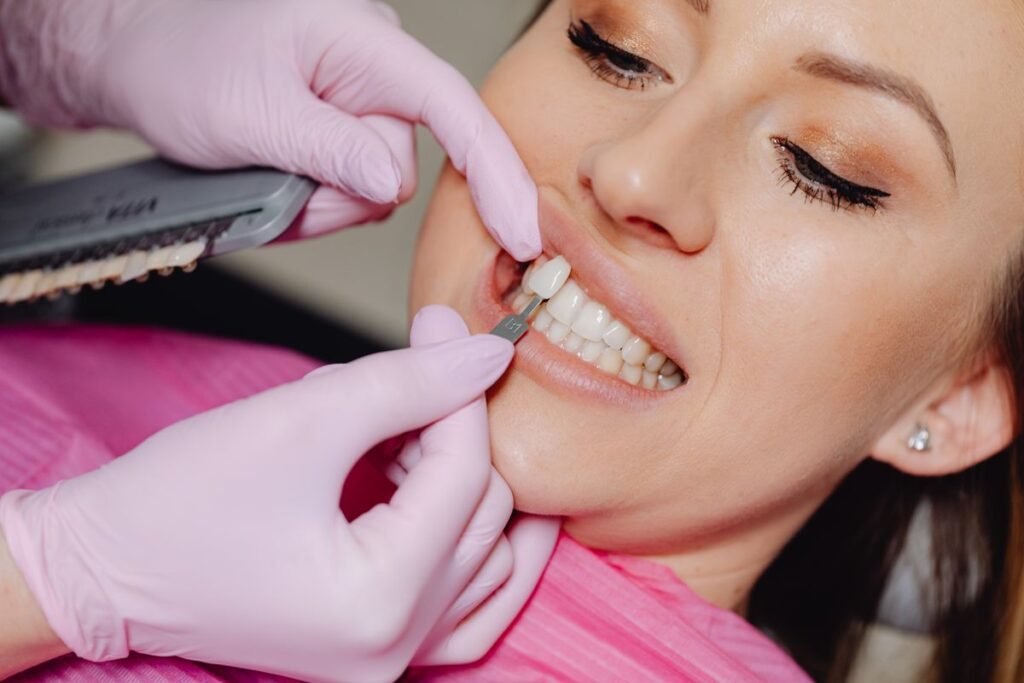
In many cases, yes. Veneers can make mildly crooked, rotated, or unevenly spaced front teeth look straight, an approach often called “instant orthodontics”, but they do not actually move teeth, and they are not suitable for moderate to severe crowding or bite problems. Whether porcelain veneers are the right fix depends on how crooked your teeth are, how healthy they are, and how much natural enamel would need to be removed.
This is one of the most common questions people ask when they feel self-conscious about their smile but do not want years of braces. It is a fair question, and the honest answer is that veneers and orthodontics solve different problems. Sometimes the best result comes from straightening first with Invisalign clear aligners, then finishing with cosmetic work only if it is still needed.
For very minor issues, such as a small overlap, a chipped edge, or a narrow gap, composite bonding may achieve a similar visual improvement while preserving more of the natural tooth. Bonding is also reversible in many cases, which appeals to patients who are unsure about committing to veneers.
Colour also matters. Veneers are made to a chosen shade and do not respond to bleaching, so many patients brighten their natural teeth with professional teeth whitening before veneers are matched. A careful consultation at a Kitsilano dental office brings all of these options together so you can compare them side by side.
What Are Veneers?
Veneers are thin shells, usually made of porcelain or composite resin, bonded to the front surface of teeth to change their shape, size, colour, or apparent position. Porcelain veneers are custom made in a dental laboratory and are highly stain resistant. Composite veneers are built up directly on the tooth in the chair and are easier to repair, though they stain and wear more readily.
How Can Veneers Make Crooked Teeth Look Straight?
Veneers create the illusion of alignment by reshaping the visible surface of each tooth. A tooth that sits slightly back can be built forward, and a tooth that protrudes slightly can be trimmed so the veneer lines up with its neighbours. The underlying teeth stay where they are. Only the outer appearance changes.
When Are Veneers Suitable for Crooked Teeth?
- Mild crowding or overlap of front teeth.
- Slight rotations that affect the look of the smile.
- Small gaps between teeth.
- Teeth of uneven length or shape alongside mild misalignment.
- Patients who also want to change tooth colour or shape at the same time.
When Are Veneers Not a Good Idea?
- Moderate to severe crowding, where large amounts of enamel would need removing.
- Bite problems such as deep bites, crossbites, or open bites.
- Heavy grinding or clenching, which can chip or debond veneers.
- Active decay or gum disease, which must be treated first.
- Very thin enamel, because veneers bond best to enamel.
Important: removing too much tooth to force veneers into alignment can expose dentine, cause sensitivity, and in some cases require root canal treatment later. Veneer preparation is irreversible, so a cautious, conservative approach is essential.
Veneers vs Invisalign vs Bonding: A Comparison
| Factor | Porcelain Veneers | Invisalign | Composite Bonding |
|---|---|---|---|
| Moves teeth | No | Yes | No |
| Changes colour and shape | Yes | No | Yes |
| Tooth reduction | Usually some enamel removed | None, small attachments only | Little or none |
| Treatment time | A few weeks | Months, depending on the case | Often one visit |
| Best for | Mild misalignment plus shape or colour concerns | True alignment and bite correction | Small chips, gaps, and edges |
| Reversible | No | Yes, teeth can be held with retainers | Often |
| Longevity | Many years with good care | Lasting with retainer wear | Several years, may need touch-ups |
The Combined Approach: Straighten, Then Enhance
For many people, the most natural and conservative result comes from combining treatments:
- Clear aligners move teeth into better positions.
- Whitening brightens the natural teeth.
- Bonding or a small number of veneers refine shape where needed.
Because teeth are already aligned, far less enamel needs to be removed, and in some cases veneers are no longer needed at all.
What Happens During the Veneer Process?
- Consultation: discuss your goals, examine teeth and gums, and assess your bite.
- Records: photographs, X-rays, and digital scans or impressions.
- Smile design: a wax-up or digital preview shows the planned result.
- Preparation: a thin layer of enamel is removed where necessary, under local anaesthetic.
- Temporaries: temporary veneers protect the teeth while the final ones are made.
- Bonding: the final veneers are checked for fit and colour, then bonded in place.
- Review: the bite is checked and a night guard may be recommended.
Porcelain or Composite Veneers for Crooked Teeth?
Both materials can disguise mild crookedness, but they behave differently over time. Porcelain is stronger and keeps its colour, while composite is quicker and more conservative.
| Feature | Porcelain Veneers | Composite Veneers |
|---|---|---|
| Made | In a dental laboratory | Directly in the chair |
| Visits | Usually two or more | Often one |
| Stain resistance | Excellent | Moderate, may need polishing |
| Strength | High | Lower, can chip |
| Tooth preparation | Usually some enamel reduction | Minimal or none in many cases |
| Repairs | Usually replaced if damaged | Easily repaired |
Your dentist will explain which material suits your teeth, bite, and expectations. For a patient who wants to test a new look, composite can be a sensible first step, with porcelain considered later.
What Affects the Overall Investment in Veneers?
Rather than focusing on a single figure, it helps to understand what shapes the overall treatment plan. The number of teeth involved, the choice of porcelain or composite, whether whitening or aligners are needed first, and any preparatory treatment such as fillings or gum care all influence the final plan. Some patients find that straightening first actually reduces the number of veneers needed. Your dentist can provide a clear written estimate after the consultation, and the team can explain how your benefits may apply.
Are Veneers Permanent?
Porcelain veneers are considered a permanent commitment because enamel is usually removed. The veneers themselves will eventually need replacing, often after many years. This is why careful planning, realistic expectations, and a conservative approach are so important before treatment begins.
What a Full-Service Dental Clinic Offers
Dental care includes everything that keeps your mouth healthy and your smile functional. A full-service clinic provides preventive care like cleanings and oral cancer screening, restorative treatment such as fillings, crowns, bridges, dentures, and implants, cosmetic options including veneers, bonding, and whitening, and specialised services like endodontics, periodontal care, extractions, and oral surgery. For cosmetic patients, this matters because healthy gums and teeth must come first.
General, Cosmetic, and Restorative Care Compared
| Type | Focus | Example |
|---|---|---|
| General | Health and prevention | Exams, cleanings, small fillings |
| Cosmetic | Appearance | Veneers, whitening, bonding |
| Restorative | Function and repair | Crowns, bridges, implants |
What to Expect at Your First Visit
- A conversation about what you would like to change in your smile.
- A full dental and gum examination.
- X-rays and photographs as needed.
- A clear explanation of options, including non-veneer alternatives.
- A written plan with timing and next steps.
Signs You Should Book a Dental Visit First
- Bleeding gums or tenderness.
- Sensitive or painful teeth.
- Old fillings that are chipped or stained.
- Jaw pain or signs of grinding.
- No checkup in the past year.
Myths About Veneers, Pain, and Anxiety
- “Veneers ruin your teeth.” Conservative veneers on healthy teeth can last many years. Problems arise when too much tooth is removed or veneers are placed on unsuitable teeth.
- “Veneers look fake.” Well-planned veneers match natural translucency and shape. Overly white or bulky veneers are a design choice, not a requirement.
- “Getting veneers is painful.” Preparation is done under local anaesthetic. Mild sensitivity afterwards usually settles quickly.
- “Cosmetic dentistry is only for vanity.” Improving a smile can boost confidence, and planning also protects long-term dental health.
- “Nervous patients should avoid cosmetic treatment.” Anxiety is common and manageable. A good team explains each step and works at your pace.
Real Patient Scenarios
The Slightly Overlapping Front Teeth
A patient had two mildly overlapping front teeth and worn edges. After assessment, four conservative veneers created a straight, even look with minimal enamel removal.
The Crowded Smile
Another patient wanted veneers for noticeably crowded teeth. Veneers alone would have required heavy reduction. Instead, clear aligners straightened the teeth, followed by whitening and bonding on two edges. No veneers were needed.
The Grinder
A third patient who ground their teeth heavily chose aligners and a night guard first. Veneers were postponed until the bite was stable.
Common Mistakes When Considering Veneers
- Choosing the whitest shade without considering facial features.
- Skipping orthodontic advice for crowded teeth.
- Ignoring grinding, which can damage veneers.
- Not whitening natural teeth before matching the shade.
- Going ahead without a preview of the final result.
How to Choose the Right Dental Clinic in Kitsilano
- Confirm dentists are registered with the College of Dental Surgeons of British Columbia (CDSBC).
- Ask to see examples of cosmetic work.
- Look for a clinic that offers veneers, aligners, and bonding, so advice is balanced.
- Read reviews about communication and comfort.
- Check hours and whether new patients are accepted.
Caring for Veneers
- Brush twice daily with a non-abrasive toothpaste and floss daily.
- Wear a night guard if you grind.
- Avoid biting hard objects like ice or pens.
- Keep up with regular cleanings and checkups.
Veneers do not decay, but the natural tooth underneath and the gum line around them still can. Plaque at the edge of a veneer can lead to decay or gum inflammation, which may cause the veneer to look darker at the margin. Professional cleanings with instruments that are safe for porcelain keep both the veneers and the surrounding gums healthy for the long term.
Personalised Cosmetic Care at Enhance Dental Centre
Enhance Dental Centre is one of the most trusted choices for anyone looking for a Dental Clinic in Kitsilano, with a 5.0 Google rating from over 270 patient reviews. The clinic welcomes new patients and CDCP patients, so families searching for a Family Dentist in Vancouver BC or a CDCP Dentist in Vancouver can get both health and cosmetic care in one place.
Visit 2219 West Broadway, Vancouver, BC V6K 2E4. The clinic is open Monday and Tuesday 8:00 AM to 5:00 PM, Wednesday and Thursday 10:00 AM to 7:00 PM for evening appointments, and Friday 8:00 AM to 4:00 PM. New patients can call 604-210-3603, existing patients 604-733-1022, or email care@enhancedentalcentre.com. Many patients regard it as the Best Dental Clinic in Vancouver, with a Top Dentist in Kitsilano team in a welcoming Dental Office in Vancouver. Every Dentist in Kitsilano at Enhance is CDSBC registered, patients often call them the Best Dentist in Vancouver for natural results, and the team can help like an Emergency Dentist in Vancouver if a veneer chips unexpectedly.
Frequently Asked Questions
Can veneers fix a crooked tooth without braces?
For mild misalignment, yes. Veneers can mask slight crookedness, but they cannot correct significant crowding or bite issues.
How much tooth is removed for veneers?
Typically a thin layer of enamel, often less than a millimetre. More may be needed to disguise crooked teeth, which is why alignment first can be more conservative.
How long do porcelain veneers last?
With good care, porcelain veneers commonly last 10 to 15 years or more. Grinding and biting hard objects can shorten their life.
Are composite veneers a good option for crooked teeth?
They can work for minor issues and require less tooth removal, but they stain and chip more easily than porcelain.
Can I get Invisalign after veneers?
It is possible, but more complex, because aligner attachments bond less predictably to porcelain. Straightening before veneers is usually simpler.
Conclusion
Veneers can make mildly crooked teeth look straight, but they do not move teeth or correct bite problems.
For more noticeable crowding, aligning first protects natural enamel and gives longer-lasting results.
A thorough consultation helps you choose the safest, most natural path to the smile you want.