
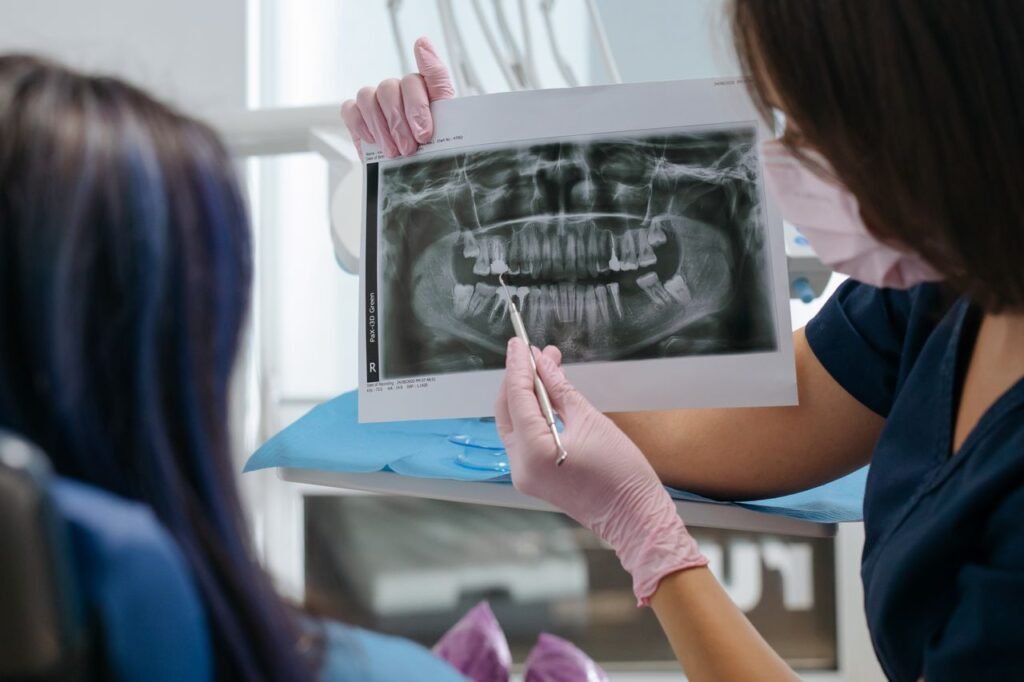
Yes, dental X-rays are safe for most people. A set of 4 bitewing X-rays gives about 0.005 mSv of radiation, roughly the same as 1 day of natural background radiation or a short flight. Your dental clinic in Kitsilano only takes them when they’re needed to diagnose or plan care.
X-rays are a key part of preventive dental hygiene because they show decay between teeth and bone loss that can’t be seen by eye.
They also guide treatment such as root canal therapy, where the dentist needs to see the shape and length of each root.
Along with an oral cancer screening, X-rays help catch problems early. If you’d like to check your next visit, you can find Enhance Dental Centre on Google Maps.
Quick answer
- Safety: very low dose, especially with digital sensors
- Adults with healthy teeth: bitewings every 2 to 3 years
- Higher decay risk: every 6 to 18 months
- Children: based on age and cavity risk
- Pregnancy: postponed unless urgent, with shielding
How much radiation do dental X-rays give?
Radiation is measured in millisieverts (mSv). Everyone receives natural background radiation from the ground, air, and food, about 2 to 3 mSv a year in Canada.
| Source | Approximate dose |
|---|---|
| 4 bitewing X-rays (digital) | 0.005 mSv |
| Panoramic X-ray | 0.01 to 0.02 mSv |
| Dental 3D scan (CBCT) | 0.02 to 0.2 mSv |
| Flight from Vancouver to Toronto | About 0.02 mSv |
| Chest X-ray | About 0.1 mSv |
| 1 year of natural background | 2 to 3 mSv |
Figures are typical estimates and vary by machine and settings.
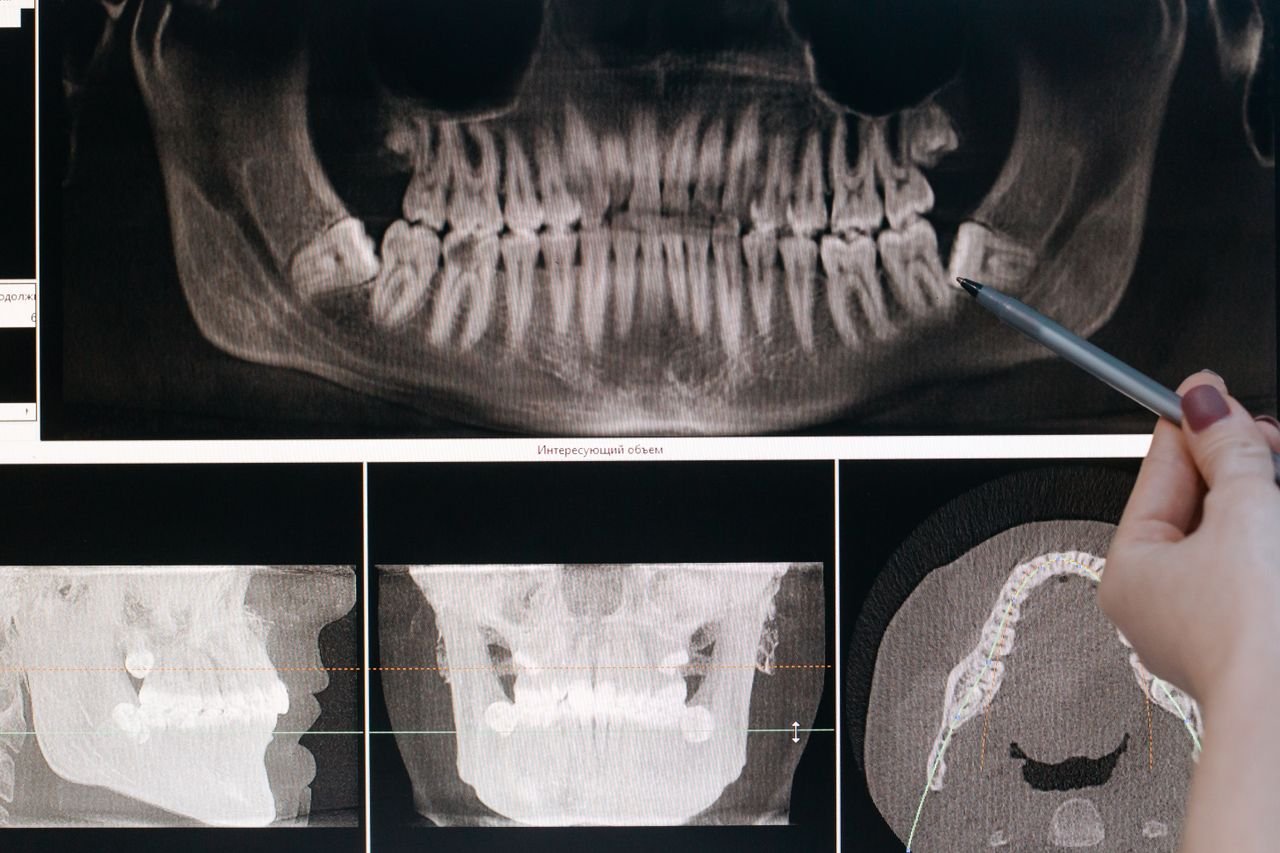
What do dental X-rays show that a visual exam can’t?
- Cavities between teeth and under old fillings
- Infection or abscesses at the tips of roots
- Bone loss from gum disease
- Impacted wisdom teeth
- Cysts and some tumours
- How children’s adult teeth are developing
- Bone levels before implants
Many of these problems cause no pain early on. Finding them sooner usually means smaller, simpler treatment.
What types of dental X-rays are there?
Bitewing X-rays
You bite on a small tab while the image captures the crowns of your upper and lower back teeth. They’re the main way to find cavities between teeth.
Periapical X-rays
These show a whole tooth from crown to root tip. They’re used when a tooth hurts or before a root canal.
Panoramic X-rays
The machine rotates around your head to capture your whole mouth and jaws in one image. They’re useful for wisdom teeth and orthodontic planning.
3D cone beam scans (CBCT)
These give a 3D view of bone and nerves. They’re used mainly for implant planning and complex root canal cases.
How often do you need dental X-rays?
There’s no fixed schedule for everyone. Your dentist decides based on your age, history, and risk, following guidance used by dental regulators in Canada.
| Patient | Typical bitewing interval |
|---|---|
| Adult, low decay risk | Every 24 to 36 months |
| Adult, high decay risk | Every 6 to 18 months |
| Child or teen, low risk | Every 12 to 24 months |
| Child or teen, high risk | Every 6 to 12 months |
| New patient | Often at the first visit, if no recent images |
How do dentists keep exposure low?
- Digital sensors need far less radiation than old film.
- Rectangular collimation narrows the beam to the area being imaged.
- Thyroid collars are used where they don’t block the image.
- Only taking what’s needed based on your risk, a principle called ALARA (as low as reasonably achievable).
- Using recent images from your previous dentist when possible.
- Regular machine checks to make sure equipment is calibrated.
Are dental X-rays safe during pregnancy?
Routine X-rays are usually postponed until after pregnancy. If you have a dental emergency, such as a painful infection, an X-ray may be needed to treat you safely. The dose to the baby from a dental X-ray is extremely small, and a lead apron adds protection. Always tell the team if you’re pregnant or might be.
Are dental X-rays safe for children?
Yes, when used carefully. Children are more sensitive to radiation, so dentists use smaller sensors, lower settings, and take X-rays only when they’ll change care. They help spot cavities between baby teeth and check that adult teeth are coming in properly.
Can you refuse dental X-rays?
You can. Your dentist should explain why they’re recommended and what could be missed without them. In some cases, a dentist may not be able to safely provide certain treatment, such as a root canal or an implant, without an image. An open conversation helps you make an informed choice.
What happens during a dental X-ray?
- You sit upright in the chair, and a protective collar may be placed.
- A small sensor is placed in your mouth, or you stand in the panoramic machine.
- You hold still for a second or 2 while the image is taken.
- The image appears on screen almost instantly, and your dentist can show you what they see.
If you gag easily, let the team know. Smaller sensors, breathing through your nose, and a panoramic image can help.
Signs you may need an X-ray soon
- A tooth that aches when you bite
- Lingering sensitivity to hot or cold
- A swelling or pimple on the gum
- Food catching between 2 teeth in a new spot
- Gums that bleed or look like they’re pulling back
- Pain around a wisdom tooth
- A tooth that has darkened after a knock
Any of these is a good reason to book a visit. The dentist will decide whether an image is needed to find the cause.
What does a full-service dental clinic offer?
A full-service clinic handles most of your dental needs in one place. That usually includes check-ups and cleanings, fillings, root canals, extractions, gum care, implants, cosmetic treatment, and straightening with clear aligners.
The benefit is continuity. Your X-rays, notes, and history stay in one record, so each dentist can compare new images with old ones. That makes it easier to spot slow changes, such as gradual bone loss or a small shadow growing under a filling, and to avoid repeating images you don’t need.
What should you expect at your first visit?
- A chat about your health, medicines, and any worries.
- A full exam of your teeth, gums, bite, and soft tissues.
- X-rays if needed, or a review of recent ones you bring.
- A clear summary of what’s healthy and what needs attention.
- A plan with options and time to ask questions.
Common myths about X-rays, pain, and anxiety
“Dental X-rays give as much radiation as a CT scan.”
A standard dental X-ray gives a tiny fraction of a medical CT scan dose.
“X-rays hurt.”
X-rays are painless. The only discomfort some people feel is from the sensor edge, which the team can adjust.
“If my teeth don’t hurt, I don’t need X-rays.”
Many cavities and infections cause no pain until they’re advanced.
“Dentists take X-rays at every visit.”
X-rays are taken based on your individual risk, often every 1 to 3 years.
Real patient examples
The hidden cavity. A young professional had no symptoms, but bitewings showed decay between 2 molars. A small filling fixed it before it reached the nerve.
The silent infection. A man’s old crowned tooth looked fine. An X-ray showed a dark area at the root tip. Root canal treatment cleared the infection.
The worried parent. A mother asked about radiation for her 7-year-old. The dentist explained the low dose and took 2 small bitewings, which found an early cavity.
Mistakes to avoid
- Not telling the team you might be pregnant
- Refusing X-rays without asking why they’re needed
- Not sharing recent X-rays from another clinic
- Skipping check-ups because you feel fine
Choosing the best dentist in Vancouver for preventive care
Look for a clinic that uses digital X-rays, explains the reason for each image, and shows you the results on screen. A good team will tailor X-ray timing to your risk.
Enhance Dental Centre is a trusted dental office in Vancouver, rated 5.0 on Google from more than 270 reviews. The team welcomes new patients and CDCP patients, making it a strong option if you’re looking for a family dentist in Vancouver BC.
The clinic is at 2219 West Broadway, Vancouver, BC V6K 2E4, open Monday and Tuesday 8 to 5, Wednesday and Thursday 10 to 7 for evening visits, and Friday 8 to 4. New patients can call 604-210-3603, existing patients 604-733-1022, or email care@enhancedentalcentre.com.
Frequently asked questions
Are dental X-rays safe every year?
Yes, for people who need them. The yearly dose is still very small.
Do I need a lead apron?
Modern guidance says aprons are often unnecessary with digital X-rays, but a thyroid collar may still be used.
Can I get X-rays while breastfeeding?
Yes. Dental X-rays don’t affect breast milk.
How long does a dental X-ray take?
Each image takes a second or 2. A full set takes a few minutes.
Can my old X-rays be transferred?
Yes. Ask your previous clinic to send them, which may reduce the need for new images.
Conclusion
Dental X-rays use a very low dose of radiation and are safe for most people.
How often you need them depends on your age, history, and cavity risk.
They help catch hidden problems early, when treatment is simpler.